Understanding the Advantages of Twin Rotary Sheeters for Thick Paper and Paperboard
As packaging materials continue to evolve, paper converters are processing heavier and more rigid grades than ever before. Materials such as folding box board, duplex board, white top liner, kraft liner, and coated packaging board demand greater precision during the sheeting process. While conventional sheeters perform well for lighter papers, heavy paper grades often require a different cutting technology to maintain productivity and sheet quality.
This is why many paper mills and packaging manufacturers choose Twin Rotary Sheeters when working with high-grammage materials.

A Twin Rotary Sheeter uses synchronized upper and lower rotary knives that rotate together during the cutting process. Unlike a traditional Single Rotary Sheeter, which relies on a rotary top knife and fixed bottom knife, the twin rotary design creates a continuous shearing action. This significantly reduces cutting impact and allows the machine to handle thicker and stiffer materials more efficiently.

As paper weight increases, cutting resistance rises dramatically. Heavy paperboard places greater stress on the cutting system, machine frame, bearings, and drive components. When using a conventional cutting system, excessive cutting force can lead to vibration, edge cracking, dimensional variation, and reduced cutting accuracy. These problems become even more noticeable at higher production speeds.
The Twin Rotary Sheeter addresses these challenges by distributing cutting forces more evenly. Because both knives rotate in synchronization, the material is cut smoothly rather than being struck by a single cutting action. This results in cleaner sheet edges, lower dust generation, and improved dimensional stability.
For packaging manufacturers, sheet quality is critical because every subsequent process depends on accurate sheets. Printing, laminating, die-cutting, and folding operations all require consistent dimensions and defect-free edges. Poor cutting quality can increase waste, reduce efficiency, and affect the final appearance of the finished product.

Twin rotary cutting technology is particularly valuable when processing materials above 250gsm. For grades exceeding 400gsm or 500gsm, the advantages become even more apparent. The cutting system can maintain stable performance while reducing mechanical stress on the machine and minimizing operator intervention.
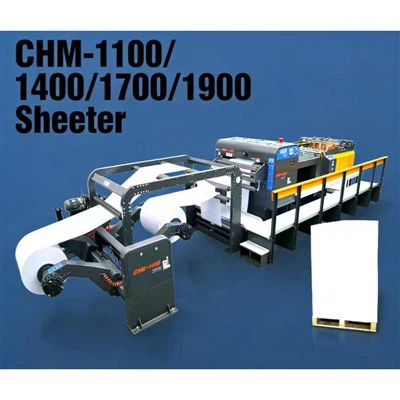
Modern Twin Rotary Sheeters such as the CHM-SGT1700 are designed specifically for these demanding applications. With synchronized rotary knives, automatic tension control, EPC web guiding systems, and high-speed conveying technology, they provide reliable production for paperboard grades ranging from 200gsm to 1000gsm.
Selecting the correct sheeting technology is not simply a matter of machine speed. The physical characteristics of the material play an equally important role. When processing heavy paper, packaging board, or high-stiffness grades, Twin Rotary Cutting provides the stability, cutting force, and precision needed to achieve consistent high-quality sheet production.
For converters seeking better performance with heavy paper grades, a Twin Rotary Sheeter is often the most effective long-term solution.
How to contact with us:
Email: chm007@szchm.com
Wechat/Phone/WhatsApp:+8617371066702
Follow me on Social Media:
Facebook: https://www.facebook.com/facebookCHMCassie/
Instagram: https://www.instagram.com/chm_sheeter_cassie/
LinkedIn: www.linkedin.com/in/chm-cassie-she-6b6200302
Youtube:www.youtube.com/@CassieShe