

Auto Double Wall Flute Lamination Pasting Machine 1650 Type
Flute Lamination Pasting Machine 1650 Type
Double Wall Flute Lamination Pasting Machine
1650 Type auto flute laminator
- Place of Origin:China
- Brand Name:DINGXING/DINGYI
- Certification:ISO/CE
- Model Number:DW-1650
Product Details
|
Max. Speed |
5000 Piece/Hour |
|
Top Sheet GSM |
120-600 |
|
Bottom Sheet GSM |
300-800 |
|
Lamination Accuracy |
±1.5mm |
|
Highlight |
Flute Lamination Pasting Machine 1650 Type, Double Wall Flute Lamination Pasting Machine, 1650 Type auto flute laminator |
Payment & Shipping Terms
|
Minimum Order Quantity |
1 |
|
Price |
USD80000-USD150000 |
|
Packaging Details |
Meteorological anti-rust film and steel bottom bracket |
|
Delivery Time |
60 DAYS |
|
Payment Terms |
L/C, D/A, D/P, T/T |
|
Supply Ability |
5 SET/MONTH |
DW-1650 Double Wall Flute Laminator
Built for heavy board jobs, not just standard lamination
The DW-1650 is not your typical flute laminator.
It's designed for plants that are dealing with double wall, multi-ply corrugated board, where normal machines start to struggle.
If you are running large cartons, home appliance boxes, or any heavy-duty packaging, you already know the issues-
misalignment, bubbles, weak bonding, and unstable feeding.
This machine is built to solve exactly those problems.
Stable production matters more than top speed
- The machine runs up to around 5000 sheets per hour, but in real production, what matters is consistency.
- Once the machine is set properly, it keeps running without frequent stops.
- No constant adjustments, no chasing alignment every few minutes.
- Positioning accuracy stays within a practical ±1.5–2 mm range, which is reliable for this type of heavy board work.
Handles double wall and multi-layer jobs with ease
What makes this machine different is its structure:
- Two bottom sheet feeders
- One top sheet feeder
This allows you to laminate:
- Double wall (5-ply) board
- Multi-layer combinations
- Heavy corrugated structures
Instead of running multiple processes, you can complete complex lamination in one pass.
Feeding system – where most problems usually start
A lot of laminators fail at feeding, especially with large or thick sheets.
On this machine:
The top sheet uses a multi-suction feeder with air assistance
The bottom sheets are transported by vacuum belts
Even thick or slightly warped board can run smoothly without jumping or skewing.
Simply put:
the thicker the board, the more you feel the advantage.
Alignment system – the real key to output quality
The machine uses a servo-controlled alignment system.
Here's how it works in practice:
- Bottom sheet position is detected continuously
- The top sheet is adjusted dynamically by servo
- Final alignment is done through a controlled pushing system
There is also a buffer before positioning, so sheets don't crash into each other or get damaged at the edges.
That's the difference between "acceptable" output and consistent sellable quality.
Gluing system – keeps cost under control
The gluing unit is simple but effective:
- Chrome-coated glue roller for even application
- Sensors to prevent glue overflow
- Automatic glue circulation system
- You get stable glue supply without overuse, which reduces waste over long runs.
Pressing section – where bonding is finalized
After lamination, the sheets go through a pressing conveyor.
This ensures:
- Strong bonding
- No bubbles
- No hollow spots
It's a straightforward design, but critical for final product quality.
Machine structure – built for long runs
The frame is reinforced to keep the machine stable at higher speeds.
Key components are selected for reliability, not just branding:
- Yaskawa servo system
- Schneider electrical parts
- Standard pneumatic components
This means easier maintenance and less downtime when something needs replacement.
Where this machine fits best
This is not a machine for every plant.
It's built for operations that need more than basic lamination:
- Double wall / 5-ply carton production
- Heavy-duty packaging
- Large format boxes
- Jobs requiring strong bonding and thick material handling
- Material range:
- Top sheet: 120–600 gsm
- Bottom sheet: 300–800 gsm
- Board thickness up to 10 mm
- Suitable for single, 3-ply, and 5-ply corrugated
In simple terms
This machine is not about chasing the highest speed.
It's about:
- Running thick board without trouble
- Keeping alignment stable
- Producing consistent, sellable sheets
- Taking on higher-value jobs that standard machines can't handle
If you want, I can also help you turn this into:
A 30-second sales pitch for quick conversations
Or a real Q&A set based on what factory owners actually ask before buying
Those are usually what close deals.
Product Description
DW-1650 Double Wall Flute Laminator
Specifications:
Note: Specifications are subject to change without notice.
|
Model |
DW-1650 |
|
|
Max.Sheet Size(L*W, mm) |
1650*1450 |
|
|
Min.Sheet Size(L*W, mm) |
450*450 |
|
|
Thickness |
Litho |
120~800gsm |
|
Middle |
300-800gsm(single flute) |
|
|
Substrate |
300~800gsm (Up to 10mm Thick) A~N Single Layer/ 3/5Layers Corrugated Boards, Grey Paperboards and Cardboards |
|
|
Accuracy |
Within ±2 mm(Subject to Paper Quality and Specifications) |
|
|
Speed |
0 -5000sheets/hour(Subject to Paper Quality and Specifications) |
|
|
Power |
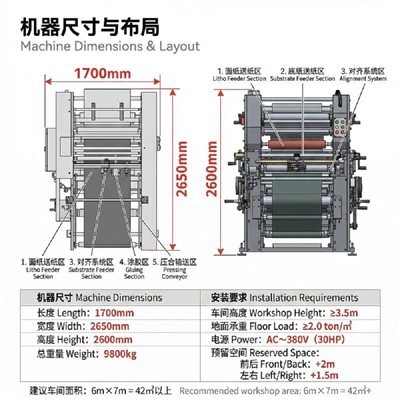
AC~380V(30HP) |
|
|
Dimension: L*W*H(MM) |
1700*2650*2600 |
|
|
Weight(KG) |
9800 |
|
Litho Paper Feeder
- Equipped with 4 paper raising caps and 4 feeding caps to ensure smooth feeding.
- Paper pressing base with air blower and two sides sub-blower for wider paper.

Substrate Two Paper Feeders
The corrugated paper is attached and goes through the Spring plates by suction belt and make the corrugated board delivery smoothly. Newly designed assistance belt helps to do the perfect suction belt feeding jobs, especially for 3/5 /7 ply.


Servo motor Alignment and Timing System
Servo motor alignment for top paper and bottom 4ply corrugated boards. Multi sensors to monitor feeding position of the bottom sheets, the upper two servo motors (Japanese Yaskawa brand) adjust the top sheets synchronously to make accurate register during lamination.
Synchronous Register Belts. Bottom two corrugated boards are registered and aligned y synchronous pushing claw that makes accurate registration. There are buffer designed before pushing claw striking the paper that prevent paper edge from damage. The micro adjuster and bearing holding system allows accurate lamination of two substrate papers conveyed.

Gluing System
The adjustable glue roller system applies evenly on the corrugated board. The special chrome plated glue roller saves glue consumption with three sensors to prevent overflow. This recycles gluing system which refills the glue in the slot at both gluing rollers by electric glue controller. The gluing system prevents glue wasting for better performance of lamination.
- Belt-Driven System
Cut down maintenance cost and lower the noise

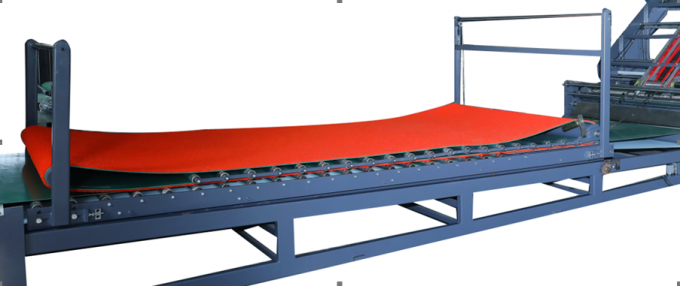
Pressing Conveyor
Integrated with upper and lower pressing conveyor, all boards are pressed and dried naturally until they are laminated tightly without air bubbles.
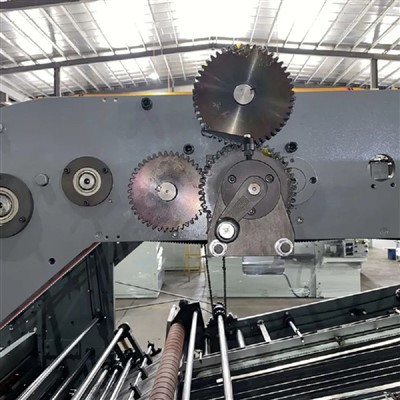
Side Frames
Newly designed machine with strengthened frames ensures stability even at highest speed and long machine life. Independent roller wheels are easy to dismantle to ensure quick replacement.
Solid and durable precision casting hand wheels.
Electrical Control System
1. Operator Panel shows all operation buttons and functions. Auxiliary Operator Panels are located in the Feeder and Pressing Conveyor. The Counter calculates laminating sheets through photocell control and Fixed Speed Device ensures fixed running speed.
2. Electrical driven systems are Schneider and Fotek & Anly from Taiwan.
Sources of Main Parts
|
Name |
Place of Origin or Materials |
|
Main motor |
Taiwan(Joint venture) |
|
Lifting motor |
Taiwan(Joint venture) |
|
Decelerator |
Taiwan(Joint venture) |
|
Glue Pump |
Taiwan(Joint venture) |
|
Clutch & Brake |
Nikka from Taiwan |
|
Electrical drive |
Schneider from France, Fotek,Anly from Taiwan |
|
Belts |
Japan |
|
Air Blower |
Taiwan(Joint venture) |
|
Air pump |
Becker |
|
Servo motor |
Yaskawa |
Tags:
Double Wall Flute Lamination Pasting Machine
PLC Flute Lamination Pasting Machine
Corrugated Box Lamination Machine
DW-1650 – Real Questions from a Printing Plant Owner
1. I already have a laminator. Why would I need this one?
If your current machine is only handling single flute or lighter jobs, it will struggle once you move into double wall or heavy board.
This machine is not a replacement for basic work -
it's what you need when you want to take higher-margin, heavier packaging orders that your current setup can't run reliably.
2. Can it really run double wall without issues? Or just in theory?
It's built for that purpose.
The dual bottom feeder structure is designed to handle multi-layer corrugated, not just single flute with a thicker spec.
In real production, the key difference is:
you don't have to slow down too much or fight constant misalignment.
3. What happens when the board is slightly warped? Will it still run?
That's exactly where most machines fail.
With the vacuum belt transport and air-assisted feeding,
this machine can handle moderately warped board without causing frequent stops.
Of course, extremely bad board will always be a problem -
but under normal factory conditions, it runs stable.
4. How much adjustment is needed during production?
Once properly set, very little.
You don't need an operator constantly standing there correcting alignment.
The servo system adjusts positioning automatically during the run.
That means:
● Less operator stress
● More consistent output
● Lower dependency on highly skilled labor
5. What about glue consumption? Will it waste more?
No, actually it's more controlled.
The glue system keeps a stable and even application,
so you don't need to over-apply just to "play safe".
Over time, that saves a noticeable amount of glue cost, especially on large-volume jobs.
6. Is the bonding strong enough for heavy cartons?
Yes, that's one of the main strengths.
The pressing section ensures the sheets are properly bonded before delivery.
You don't get the common issues like:
● bubbles
● weak edges
● layers separating later
For export cartons or heavy packaging, this is critical.
7. How difficult is it to train operators?
If your team has experience with laminators, they will pick it up quickly.
The operation logic is straightforward.
The key systems (feeding, alignment, pressing) are not complicated to understand.
Usually, a few days of training is enough to run production.
8. What about maintenance and spare parts?
This is a practical machine, not something exotic.
Main components are from well-known brands like Yaskawa and Schneider,
so parts are easier to source compared to some lesser-known systems.
Routine maintenance is standard:
● cleaning glue system
● checking belts and suction
● basic lubrication
Nothing unusual or difficult.
9. Will this machine really reduce my production cost?
Not by speed alone.
The real savings come from:
● fewer rejected sheets
● less manual rework
● more stable production
● ability to take higher-value orders
So it's more about profit per job, not just output per hour.
10. What kind of orders justify investing in this machine?
If you are mainly doing:
● single flute cartons
● low-margin standard jobs
Then this machine may be underutilized.
But if you are targeting:
● home appliance packaging
● heavy-duty cartons
● export packaging
● double wall / 5-ply jobs
Then this machine becomes a tool to move into a different level of business.
This machine is not for doing more of the same work.
It's for taking the kind of jobs your current machine cannot handle well - and making money from them.
Hot Tags: auto double wall flute lamination pasting machine, China auto double wall flute lamination pasting machine manufacturers, suppliers, factory, high speed 5ply laminator, Auto Double Wall Flute Lamination Pasting Machine, High Speed 5 Ply Flute Laminator, 5 Layer Paperboard Flute Laminating Machine, 5 ply flute laminator, 5 ply corrugated laminate machine