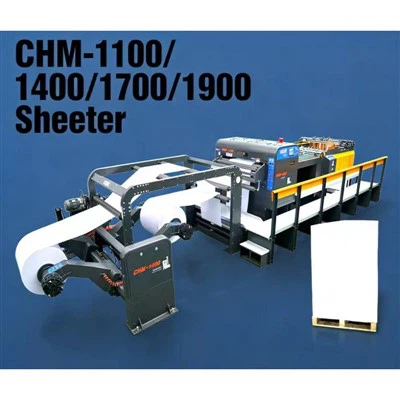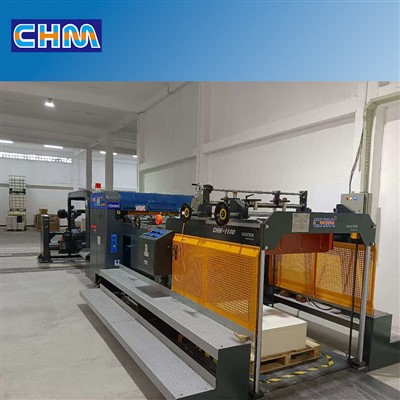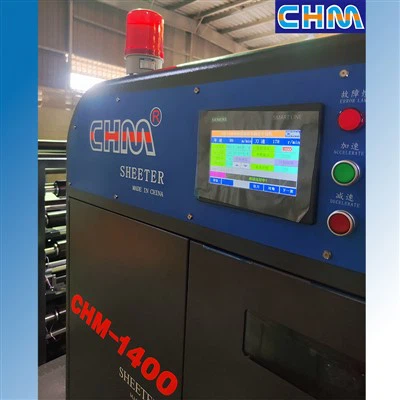
In the paper converting industry, there is a common misconception about paper sheeter selection: many people believe that GSM (grams per square meter) is the only factor that matters-for example, using a single-knife machine for 60–250 GSM paper and switching to a dual-knife machine above 250 GSM.
In actual production, however, it is not that simple.
Different paper types with the same GSM can behave very differently during sheeting. A 250 GSM white paperboard and a 250 GSM kraft paper can have completely different sheeting requirements. The former may require higher cutting force and greater knife-shaft rigidity, while the latter may be processed effectively with a standard single-knife machine. Selecting a machine based only on GSM can therefore lead to the wrong equipment choice.
So, what should you actually consider when selecting a paper sheeter?
Paper Stiffness and Coating Matter More Than GSM
The first principle is: look at paper stiffness and coating characteristics first, then GSM, and finally roll diameter and paper width.
Why? Because the physical properties of the paper directly determine the mechanical requirements of the sheeting process. The key questions are whether the paper requires flexible web handling or high cutting force, and whether its surface is sensitive to scratching or abrasion.
Take uncoated offset paper and coated paper as examples. Even at the same GSM, they can present different production challenges. Uncoated paper may be more sensitive to stretching, wrinkling, and static electricity, while coated paper requires greater attention to surface protection, including coating damage and powdering.
Five Paper Categories, Five Selection Strategies
Based on their physical characteristics, common paper types can be divided into five major categories.
1. Lightweight, Flexible, Uncoated Paper (50–120 GSM)
Typical products include offset paper, writing paper, thin paper, and lightweight copy paper.
These papers generally have lower stiffness and no surface coating. During sheeting, they can be sensitive to stretching, wrinkles, and static electricity. Multiple-roll unwinding can also create synchronization problems.
A single-knife sheeter with a dedicated low-tension control system and static eliminator is generally suitable. Lower-GSM paper can normally support more rolls during unwinding; for example, 60–80 GSM paper may allow multiple-roll production depending on the machine configuration.

2. Medium-GSM Printing and General Packaging Paper (120–250 GSM)
Typical products include coated paper, matte-coated paper, kraft paper, and linerboard.
These papers have moderate stiffness, while some have coated or sensitive surfaces. Production issues may include surface damage, coating powdering, and web wandering, particularly with large-diameter rolls.
Coated and matte papers may benefit from servo-driven control and suitable pressure rollers to protect the surface. Kraft paper and linerboard may require automatic edge guiding and reinforced pressure rollers for more stable web handling.

3. High-GSM, Stiff Packaging Paperboard (250–550 GSM)
Typical products include white paperboard, coated paperboard, and food packaging board.
These materials have higher stiffness, greater thickness, and higher cutting resistance. A standard single-knife machine may experience difficulties such as rough edges, incomplete cutting, or pressure marks when processing certain high-GSM grades.
For demanding high-GSM paperboard applications, a reinforced dual-rotary-knife sheeter can provide more stable cutting through a continuous shearing action. Roll handling is also typically more demanding, and single-roll unwinding may be preferred depending on the material and machine design.

4. Extra-Thick Industrial Paperboard and Composite Materials (550–1000 GSM)
Typical products include greyboard, duplex greyboard, industrial paperboard, and certain composite materials.
These materials are significantly thicker and more rigid, creating high cutting loads and potentially greater vibration during processing.
Such applications may require a heavy-duty, customized dual-rotary-knife sheeter, together with a reinforced frame, heavy-duty knife shaft, suitable pressure rollers, and a dedicated unwinding system.

5. Special-Application Papers (120–400 GSM)
Typical products include PE-coated kraft paper, moisture-resistant composite paper, metallized paper, and laminated or holographic paper.
These materials may have special surface characteristics, including higher friction sensitivity, slippery surfaces, or adhesive tendencies.
Depending on the material, suitable configurations may include non-stick silicone pressure rollers, controlled web tension, anti-static systems, and appropriate feeding configurations. The maximum number of rolls should be determined according to the actual material properties and machine capacity.

Thick Paper Does Not Automatically Mean "Double Knife," and Thin Paper Does Not Automatically Mean "Single Knife"
Two important points should be emphasized.
High-GSM paperboard may require a reinforced dual-knife configuration when its stiffness and cutting resistance exceed the capability of a standard single-knife machine.
At the same time, thin paper does not necessarily benefit from a heavy-duty dual-knife system. Excessive pressure or an unsuitable web-handling configuration can increase the risk of wrinkles, stretching, or other defects.
Therefore, a dual-knife machine is not simply an "upgraded version" of a single-knife machine. The two configurations are designed to address different material and production requirements.
Why Can Thick Paper Require Single-Roll Unwinding?
Why can't thick paper simply be processed with more rolls to increase productivity?
The answer involves four main mechanical factors: machine load, rotational forces, tension synchronization, and edge-guiding requirements.
As GSM increases, the weight of each parent roll also increases. Multiple heavy rolls can place greater loads on the unwinding stand, shafts, bearings, and machine frame.
At higher speeds, heavy rolls also generate greater rotational forces, which can contribute to vibration or web instability. In addition, stiffer materials are generally more difficult to synchronize across multiple rolls.
Therefore, single-roll unwinding may be required for high-GSM materials, depending on the roll diameter, machine design, paper stiffness, and actual production conditions.
The Correct Logic for Paper Sheeter Selection
The correct selection process can be summarzed in three steps:
- Identify the paper category: lightweight flexible paper, medium-GSM printing paper, high-GSM paperboard, extra-thick board, or special-application paper.
- Check the GSM range: use it to determine the appropriate machine model and configuration.
- Check paper width and roll diameter: select the appropriate machine width and unwinding system.
Do not select a paper sheeter based on GSM alone. Two papers with the same GSM can require significantly different machine configurations.
Before choosing a machine, ask a more important question:
What exactly are you going to cut-and what are the stiffness, coating, thickness, and web-handling characteristics of that paper?
Understanding these factors is the first step toward selecting the right paper sheeter.
How to contact with us:
Email: chm007@szchm.com
Wechat/Phone/WhatsApp:+8617371066702
Follow me on Social Media:
Facebook: https://www.facebook.com/facebookCHMCassie/
Instagram: https://www.instagram.com/chm_sheeter_cassie/