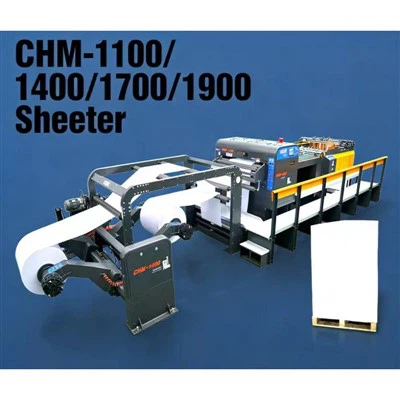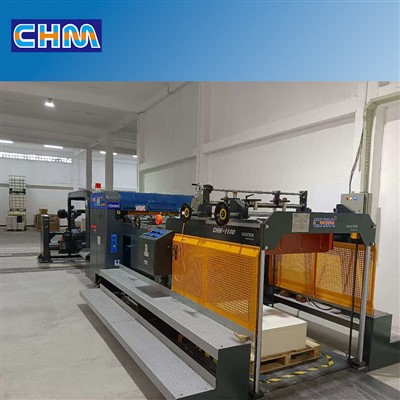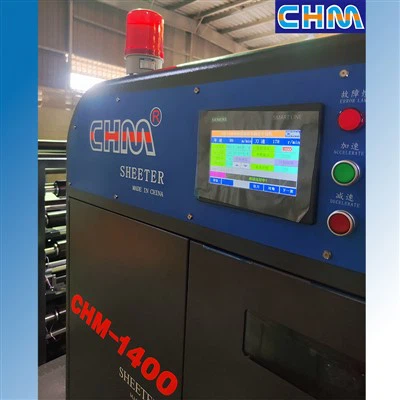
In many mills, capacity expansion doesn't fail because of demand.
It fails because the cutting section becomes the bottleneck.
On paper, most sheeters can "cut."
In production, the real question is different:
Can it cut consistently, at speed, and without hidden cost?
Across different plants and paper grades, three issues show up repeatedly.

1. Thick Board Doesn't Fail the Machine - The Cutting Method Does
When processing 350–400 gsm board and above, many mills notice the same pattern:
edges are not square
slight bevel appears
stacking becomes inconsistent
This is not usually a blade sharpness issue.
It comes from how the cut is made.
A single-rotary system relies on a momentary impact.
On thicker, stiffer paper, that impact creates lateral force before the material fully separates.
At low speed, it's less visible. At higher speed, the deviation becomes obvious.
A double-rotary sheeter changes the cutting mechanics.
With upper and lower knives rotating together, the cut becomes continuous rather than impact-based.
The material is sheared progressively, which reduces lateral stress.
In practice, this is why mills see:
cleaner edges
more consistent squareness
fewer adjustments when switching between grades
2. Blade Wear Is Not Random - It Follows Load Distribution
Frequent blade replacement is often treated as a maintenance issue.
In reality, it's a structural one.
In single-rotary systems:
the lower blade remains fixed
load is concentrated in a limited contact zone
wear accumulates unevenly
This leads to:
faster dulling
inconsistent cut quality over time
more frequent downtime for blade change
In a double-rotary setup, the contact relationship changes.
both blades rotate
load is distributed across the cutting edge
localized wear is reduced
The result is not just longer blade life, but more stable performance between maintenance cycles.
Many mills report:
longer intervals between replacements
more predictable maintenance planning
fewer quality fluctuations linked to blade condition
3. High-Speed Instability Starts with Vibration, Not Power
When production moves beyond 300 m/min, another issue appears:
noise increases
machine vibration becomes noticeable
cut accuracy starts to drift
This is often mistaken as a motor or drive limitation.
In most cases, it's a dynamic balance issue.
Single-rotary cutting introduces periodic impact forces.
At higher speeds, these forces can approach the machine's natural frequency, leading to resonance.
That's when instability begins.
A double-rotary system reduces this effect by:
smoothing the cutting action
minimizing impact peaks
improving overall dynamic balance
This is why, under comparable conditions, mills can run at higher speeds without sacrificing stability.

What Changes in Real Production
The difference between the two systems is not just technical-it shows up in daily operation:
less time spent adjusting cut quality
fewer interruptions linked to blade condition
more stable output at higher speeds
It's not about reaching a higher maximum speed on paper.
It's about being able to run close to that speed, consistently.
When Does a Double-Rotary Sheeter Make Sense?
Based on field use, the shift typically becomes necessary when:
paper grade moves above 300–350 gsm
production speed requirements increase
quality consistency becomes a priority for downstream processes
CTA
If your line can "cut" but struggles to maintain consistency under real production conditions, it may not be a capacity issue-but a cutting method limitation.
SMH can help review your current setup and identify whether a double-rotary configuration would bring measurable improvement.
Contact SMH for a practical evaluation based on your paper grades and production targets