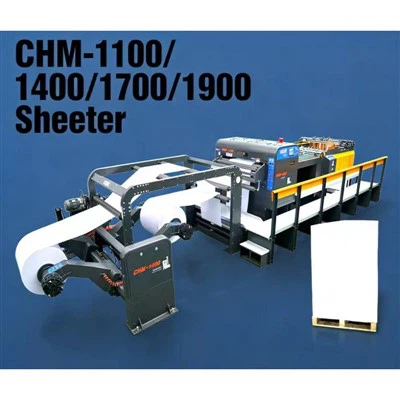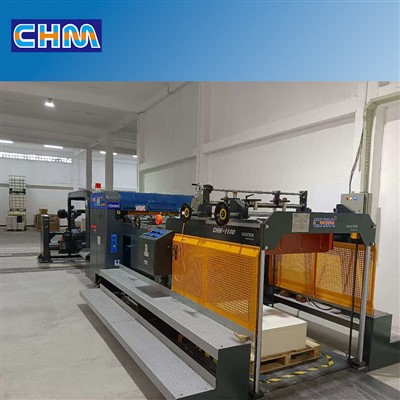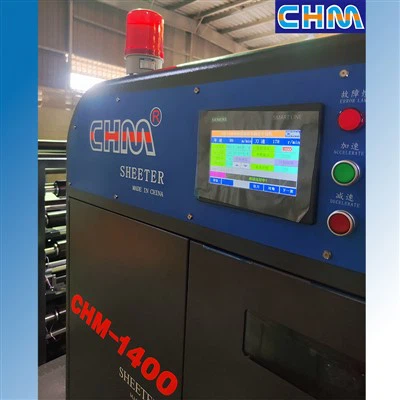
The SGT double rotary sheeter (SGT-1400/1500/1700) is a sheeting machine specially developed by CHM Machinery for high-GSM paper. It uses a synchronized rotary shear cutting principle, with upper and lower knife cylinders rotating synchronously in opposite directions. The helical blades form a moving shear contact point, producing clean cuts with minimal paper dust. It is suitable for white cardboard, grey back duplex board, kraft paper, gold and silver foil paper, and other thick paper from 200–1000 gsm. Below are the most common double rotary sheeter problems encountered in customer inquiries and after-sales service, along with their solutions.

I. Common Faults

1. Paper above 200 gsm not cut through, delamination, and excessive paper dust
Phenomenon: Paper is torn apart in layers, with many fibrous edges, and cannot be directly printed.
Causes:
Worn rotary knives, excessive knife clearance
Sand or hard objects in the paper roll causing knife chipping
Gear backlash not eliminated
Knife material grade too brittle
Solutions:
Calibrate rotary knife clearance to 0.01–0.03 mm
Replace with suitable knife grade (alloy steel rotary knives preferred for thick paper)
Eliminate gear backlash
Knife adjustment sequence: first adjust for thick paper to ensure cut-through, then switch to thin paper and fine-tune repeatedly 2–3 times
2. Two rolls cut simultaneously, press marks or spots on paper surface
Phenomenon: Belt or pressure roller marks on the paper surface, causing color differences in printing on gold card and coated paper.
Cause: Overlapping section of high-speed and low-speed belts, multi-layer paper extrusion and friction.
Solutions:
For paper above 250 gsm, two-roll simultaneous cutting is not recommended
Optional sun wheel, plush conveyor belt, or pressure-free roller vacuum suction device can reduce press marks
3. Severe curl at roll tail, production speed cannot be increased
Phenomenon: When the paper roll approaches the core, the paper curls severely, and production can only run at reduced speed.
Cause: As roll diameter decreases, paper curl stress increases, and the single anti-curl unit has insufficient correction capability.
Solutions:
Enable the automatic deceleration buffer program for roll tail
Upgrade with rubber roller anti-curl + independent air pressure regulating valve to improve roll tail curl
4. Automatic knife positioning bottom knife rusted and stuck, drive overload alarm
Phenomenon: Knife seat cannot move, overload alarm on startup.
Cause: Dust and moisture accumulate on guide rails during downtime, causing rust and jamming; lack of cleaning and maintenance in dusty workshop environment.
Solutions:
Engineer disassembles and removes rust
Install dust cover, apply a thin layer of anti-rust oil
Establish a downtime cleaning and maintenance system
5. Lifting table chain jumping teeth, paper stack misaligned
Phenomenon: Chain disengages, paper stack tilts.
Causes: Chain worn and rusted; chain pressing auxiliary device loose; insufficient counterweight; lack of lubrication.
Solutions:
Adjust chain pressing auxiliary device
Replace the entire worn chain set
Calibrate counterweight, regularly apply grease
6. Ultrasonic sensor covered with dust, tension value fixed and unchanging
Phenomenon: Tension does not change with paper roll diameter.
Causes: Sensor surface covered by paper dust; paper roll damp and deformed; wiring terminals loose.
Solutions: Clean sensor surface; replace if damaged; tighten wiring terminals.
7. SGT1500HII low-speed conveyor belt frequently torn
Phenomenon: Belt tears in a short time, frequent downtime for belt replacement.
Causes: Old belt thickness insufficient; foreign objects jammed; drive shaft and bearings worn and jumping.
Solutions: Replace with complete set of thickened low-speed conveyor belts, simultaneously inspect and replace worn drive shafts and bearings; do not just replace the belt.
8. Knife head unit oil leakage
Phenomenon: Oil seeps from knife head gearbox.
Causes: High oil temperature during high-speed operation, aging seals; old model without external cooling.
Solutions: Replace seals, inspect bearings simultaneously; upgrade to new external circulating oil cooling knife head to fundamentally reduce oil leakage.
II. Common Questions on Selection and Use
Q:How many layers of edge guiding for double rotary sheeter?
A: A: Standard configuration is 2 layers of edge guiding; optional 3 layers.
Q:What is the GSM range for double rotary sheeter?
A: A: Standard 200–1000 gsm; suitable for white cardboard, grey back duplex board, kraft paper, gold and silver foil paper, etc.; for paper above 250 gsm, single-roll production is recommended.
Q:What are the key points for knife selection on double rotary sheeter?
A: A: Tungsten carbide has high hardness but high brittleness, and is prone to chipping when encountering sand or hard objects in paper. For thick paper, alloy steel rotary knives are preferred; knife clearance should be 0.01–0.03 mm. Knife adjustment quality directly determines knife life.
Q: What are the restrictions on the number of unwinding rolls for double rotary sheeter?
A: A: High-GSM cardboard can only be produced as a single roll; some medium and low GSM paper can be cut with 2 rolls simultaneously; for above 250 gsm, single roll is recommended.
Q: What are the advantages and disadvantages of double rotary sheeter?
A: A: Advantages: pure shearing, clean cut with minimal paper dust, finished product can go directly to printing; uniform force on both sides, low vibration at high speed, stable diagonal setting once adjusted; knife wear rate lower than single rotary; strong frame rigidity, strong thick paper cutting capability. Disadvantages: high equipment purchase cost; complex debugging, long changeover time; not suitable for thin paper, small batch, multi-specification production.
Q: How to choose between single rotary and double rotary?
A: A: Selection formula: for thin paper, small batch, multiple specifications, limited budget, choose single rotary; for thick paper, large batch, high precision, high-end paper, choose double rotary.
III. Conclusion
The above are the most common faults and customer concerns for CHM-SGT double rotary sheeter. Most faults can be solved through remote parameter adjustment or replacement of wear parts, and only a few require mechanical modification and upgrading. Establishing a standardized daily maintenance system-regularly checking knife clearance, belts, and seals-can significantly reduce the probability of sudden failures and extend equipment service life.
If the above faults cannot be solved by yourself, please contact CHM after-sales engineers for remote technical support or on-site service.
How to contact with us:
Email: chm007@szchm.com
Wechat/Phone/WhatsApp:+8617371066702
Follow me on Social Media:
Facebook: https://www.facebook.com/facebookCHMCassie/
Instagram: https://www.instagram.com/chm_sheeter_cassie/
LinkedIn: www.linkedin.com/in/chm-cassie-she-6b6200302
Youtube:www.youtube.com/@CassieShe